
Neuroscience & Outreach
⏱️ 3 min read
•
📍 Madrid (UCM)
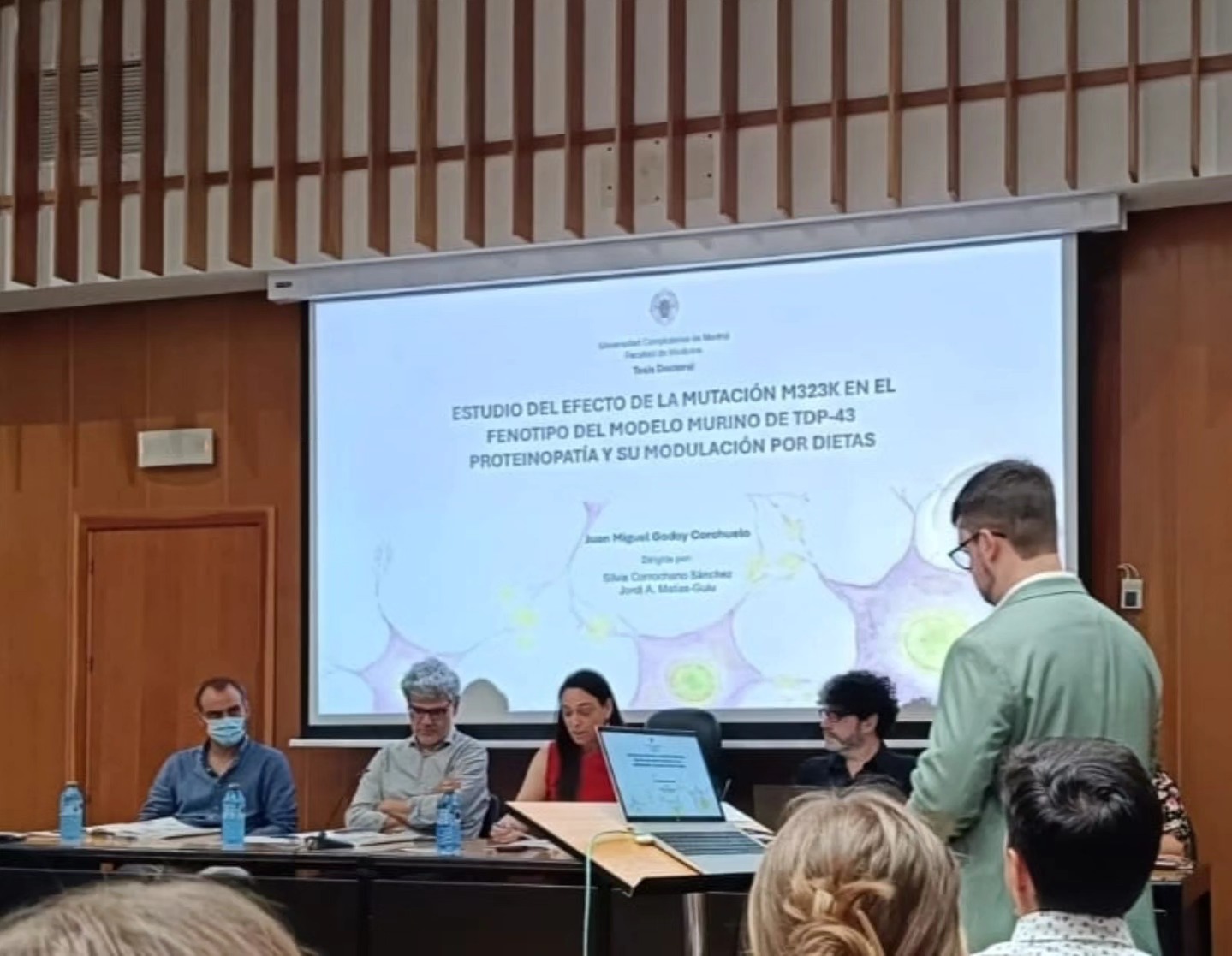
Thrilling news from Scorrochano Lab that fills our whole community with immense pride! We celebrate the outstanding doctoral thesis defense of our brilliant colleague, Dr. Juan Miguel Godoy Corchuelo, who successfully presented his research entitled: “Study of the effect of the M323K mutation on the phenotype of the TDP-43 proteinopathy mouse model and its modulation by diets”.
Co-directed by Dr. Silvia Corrochano and Dr. Jordi Matías-Guiu, Juan Miguel’s doctoral work represents a pioneering leap forward in our understanding of TDP-43 pathology and introduces groundbreaking dietary strategies to fight neurodegeneration!
💡 Key Takeaways
- Doctoral Defense Achieved: Juan Miguel Godoy Corchuelo officially earns his PhD with the highest honors.
- TDP-43 (M323K) Mutation: Unraveled the precise cellular and behavioral phenotypes driven by this pathological ALS/FTD mutation.
- Dietary Phenotype Modulation: Demonstrated that targeted dietary regimens modify disease progression, neuroinflammation, and survival.
The Scientific Core: Unraveling the TDP-43 M323K Mutation and Diet
Normally, the TDP-43 protein regulates RNA metabolism and alternative splicing within cell nuclei. When mutated—such as the pathogenic M323K mutation located in the C-terminal prion-like domain—TDP-43 exhibits an increased propensity to misfold, aggregate, and form cytotoxic inclusions in neurons and glial cells.
Juan Miguel meticulously characterized a murine model carrying the physiological Tardbp M323K point mutation, mapping its neuromuscular, cognitive, and molecular decline.
The true breakthrough of his thesis lies in dietary modulation: Juan Miguel explored whether customized nutritional interventions could mitigate the deleterious phenotype. By altering systemic lipid availability and metabolic substrates, specific diets diminished neuroinflammatory signaling, supported mitochondrial energetics, and improved behavioral performance. This proves that genetic vulnerability can be partially reshaped by metabolic intervention.
Why This Work Resonates Across the Scientific World
Juan Miguel’s thesis offers profound translational impact:
– A Validated Preclinical Model: The M323K mouse provides the scientific community with a reliable model that faithfully mimics human TDP-43 proteinopathy.
– Non-Pharmacological Horizons: Offers proof-of-concept that metabolic and nutritional strategies can be combined with pharmaceutical drugs to slow down neurodegenerative damage.
– Academic Mentorship Excellence: Highlights the dedication of directors Dr. Silvia Corrochano and Dr. Jordi Matías-Guiu in shaping world-class doctoral scientists.
Congratulations, Dr. Juan Miguel Godoy!
Juan Miguel’s humor, tireless work ethic, and sharp analytical mind have left an indelible mark on our laboratory. We wish Dr. Godoy extraordinary success in all his future scientific endeavors!
Passionate about neuroscience as much as we are?
Don’t miss any breakthrough from Scorrochano Lab! Follow us on Instagram to discover daily lab life, conference updates, and our latest scientific findings.