
Neuroscience & Outreach
⏱️ 3 min read
•
📍 Madrid (UCM)
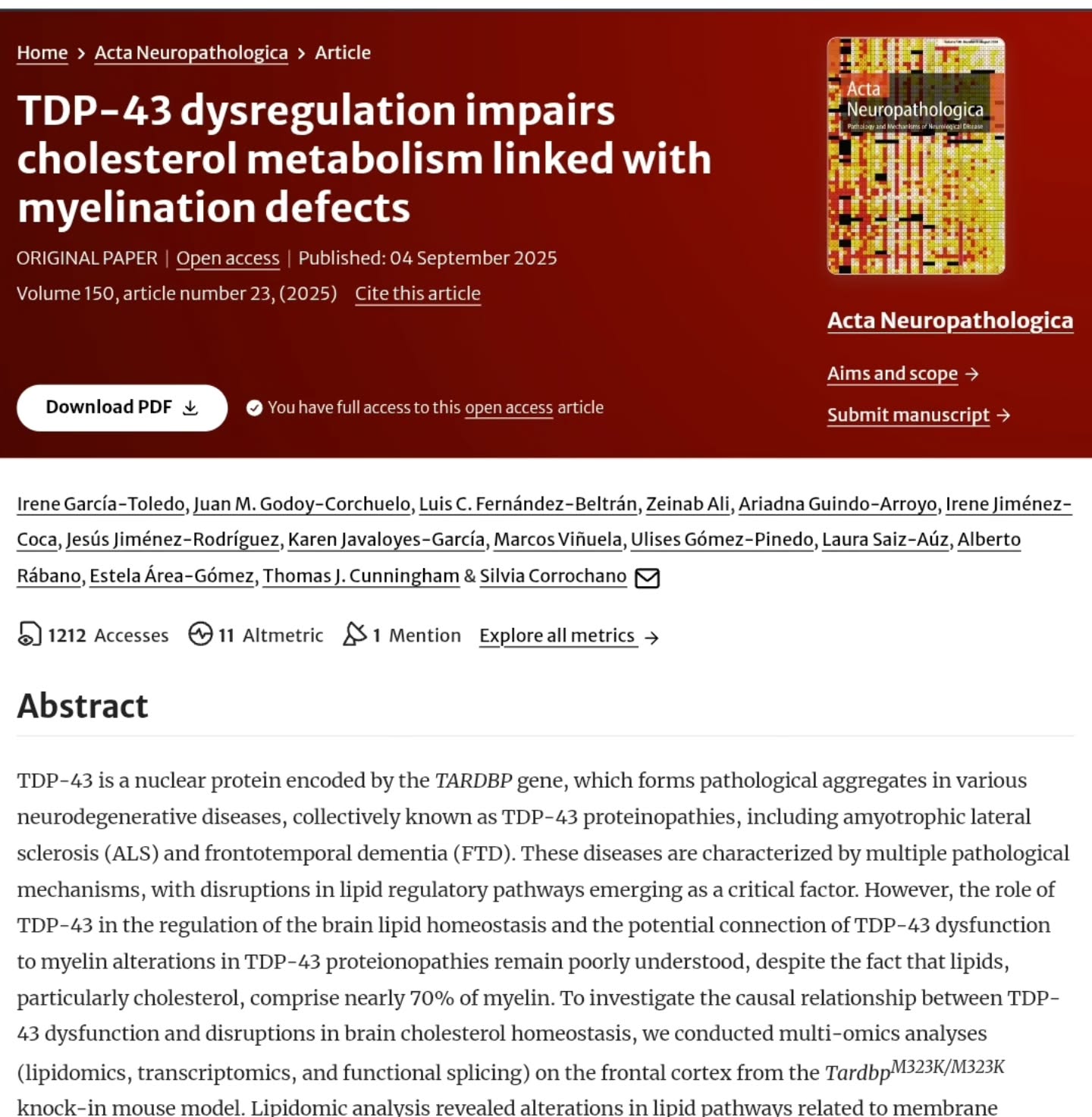
Big news to celebrate at Scorrochano Lab! We kick off the academic year with a major scientific breakthrough published in the world-renowned journal Acta Neuropathologica. Our research group, spearheaded by Dr. Silvia Corrochano, has uncovered a fundamental biological bridge connecting the pathological RNA-binding protein TDP-43, central cholesterol metabolism, and progressive myelination defects in neurodegeneration!
💡 Key Takeaways
- High-Impact Publication: Groundbreaking paper published in Acta Neuropathologica.
- TDP-43 & Cholesterol Axis: Demonstrates that dysfunctional TDP-43 severely impairs brain cholesterol homeostasis.
- Myelin Disruption: Links sterol metabolic failure directly to demyelination and axonal vulnerability in ALS and FTD.
The Biological Mechanism: When TDP-43 Disrupts the Brain’s Lipid Engine
Under normal conditions, TDP-43 (encoded by TARDBP) resides primarily in the cell nucleus, orchestrating vital RNA processing, transcription, and alternative splicing. In approximately 97% of ALS cases and nearly half of FTD cases, TDP-43 clears from the nucleus and forms toxic cytoplasmic aggregates—a hallmark known as TDP-43 proteinopathy.
Until now, how TDP-43 dysfunction triggers catastrophic neurodegeneration remained incompletely understood. Our study deployed a multi-omics strategy (transcriptomics, lipidomics, and histological characterization) across murine models carrying human TDP-43 mutations.
The findings are striking: TDP-43 pathology directly disrupts the transcriptional programs that regulate cholesterol synthesis and transport in glial cells. Because myelin—the insulating sheath surrounding axonal conduits—is composed of over 70% lipids, this cholesterol deficit causes severe, progressive demyelination. Without proper myelin insulation, axons degenerate and motor signaling fails.
Why This Paper Is a Game Changer for Biomedicine
This publication delivers immediate translational value:
– A New Therapeutic Target: Rebalancing sterol and lipid synthesis pathways offers an innovative target to protect myelin integrity in TDP-43 proteinopathies.
– Cross-Disease Relevance: Since TDP-43 pathology also appears in Alzheimer’s disease and Limbic-predominant Age-related TDP-43 Encephalopathy (LATE), these findings hold widespread neurological implications.
– Excellence of Madrid’s Biomedical Ecosystem: Highlights the caliber of scientific output produced by Scorrochano Lab in collaboration with prestigious national and international partners.
Planting Seeds, Harvesting Breakthroughs
This milestone reflects years of unwavering commitment from our PhD students, postdoctoral fellows, technicians, and clinical collaborators. We could not be prouder of our team! As we celebrate, our minds are already racing toward the next questions: How can we therapeutically restore cholesterol homeostasis in the central nervous system? Onward!
Passionate about neuroscience as much as we are?
Don’t miss any breakthrough from Scorrochano Lab! Follow us on Instagram to discover daily lab life, conference updates, and our latest scientific findings.