
Neuroscience & Outreach
⏱️ 3 min read
•
📍 Madrid (UCM)
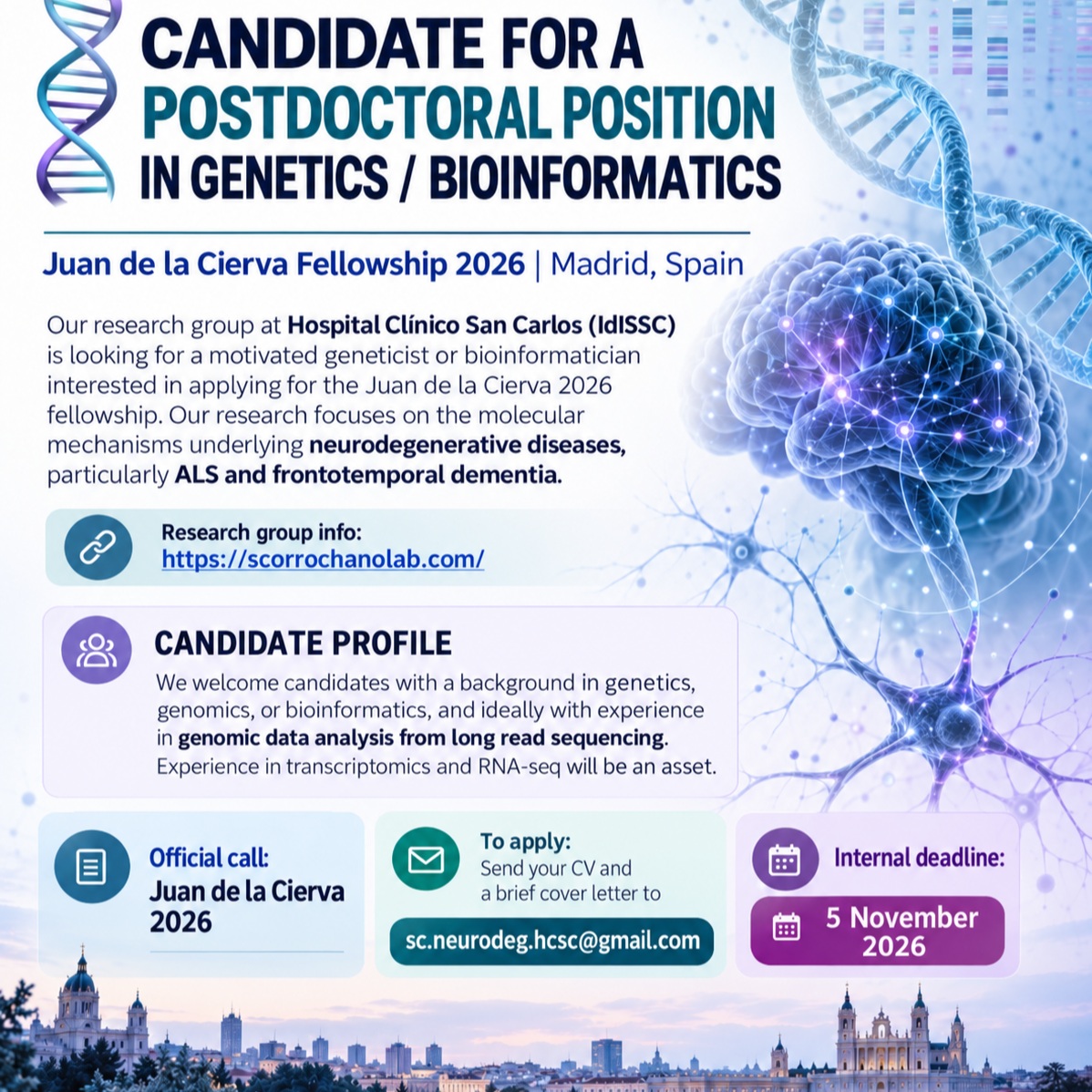
Are you a passionate bioinformatician or geneticist driven to decode the molecular secrets of the human brain? Exciting news from our team! The Scorrochano Lab, working within the vibrant research ecosystem of the Health Research Institute of Hospital Clínico San Carlos (IdISSC) and the Universidad Complutense de Madrid (UCM), is officially opening a call for an outstanding postdoctoral candidate to apply for the prestigious Juan de la Cierva 2026 Fellowship. If you are ready to apply cutting-edge genomic tools—such as long-read sequencing and transcriptomics—to tackle Amyotrophic Lateral Sclerosis (ALS) and Frontotemporal Dementia (FTD), this is your moment to join a dynamic, international, and forward-looking biomedical team in the heart of Madrid, Spain!
Key Takeaways
- Prestigious Postdoctoral Career Launchpad: We are seeking an ambitious candidate with a PhD in Genetics, Genomics, or Bioinformatics to co-apply for the highly competitive Juan de la Cierva 2026 grant.
- Cutting-Edge Technologies: The research project focuses on leveraging long-read sequencing technologies and RNA-seq transcriptomics to uncover structural genomic variants and RNA dysregulation in neurodegeneration.
- Translational Neuroscience Ecosystem: Based at IdISSC / Hospital Clínico San Carlos in Madrid, the successful applicant will work at the crossroad of computational biology, bench science, and clinical translation for ALS and FTD.
The Science Behind the Discovery: Decoding ALS and FTD with Long-Read Genomics
Amyotrophic Lateral Sclerosis (ALS) and Frontotemporal Dementia (FTD) are two devastating neurodegenerative conditions that sit on a shared clinical, genetic, and pathological spectrum. While ALS primarily causes the progressive degeneration of motor neurons leading to muscle atrophy and paralysis, FTD affects the frontal and temporal lobes, causing dramatic changes in behavior, personality, and language. Despite their distinct clinical presentations, up to 50% of ALS patients display cognitive impairment, and many FTD patients develop motor neuron symptoms. Furthermore, both diseases share key molecular hallmarks, most notably the pathological aggregation of the RNA-binding protein TDP-43 in affected neural tissues.
Unraveling the genetic architecture of the ALS-FTD spectrum has revolutionized our understanding of neurodegeneration, yet conventional genomic tools have reached clear limitations:
[ Traditional Short-Read Sequencing ] ──► Misses complex structural variants & repeat expansions
                                                   │
                                                   ▼
[ Long-Read Sequencing (Nanopore/PacBio) ] ──► Reads tens of kilobases seamlessly
                                                   │
                                                   ▼
[ High-Resolution Transcriptomics / RNA-seq ] ──► Maps novel isoforms, splicing & TDP-43 pathology
- Overcoming Structural Complexity with Long-Read Sequencing: Short-read sequencing struggles to accurately map repetitive genomic regions, complex structural variations, large insertions/deletions, and GC-rich zones. Crucially, many key genetic drivers of ALS and FTD—such as the hexanucleotide repeat expansion in C9orf72—fall precisely into these hard-to-map regions. Long-read sequencing platforms yield single reads spanning tens of thousands of base pairs, allowing us to phase haplotypes, characterize structural variants, and sequence straight through complex repetitive DNA.
- Transcriptomics and RNA Dysregulation: RNA processing deficits are at the core of TDP-43 pathology. When TDP-43 loses its normal nuclear localization, cryptic exons are aberrantly spliced into messenger RNAs, leading to nonsense-mediated decay or toxic protein products. By pairing long-read DNA/RNA sequencing with advanced transcriptomic profiling (RNA-seq), our lab maps how genetic variants alter gene expression, RNA isoform diversity, and splicing fidelity in neural models and patient samples.
The incoming postdoctoral researcher will play a pivotal role in designing computational pipelines, analyzing high-throughput multi-omics data, and translating raw genomic reads into meaningful biological mechanisms that bring us closer to targeted therapies.
Why This Milestone Matters: Fueling Computational Precision in Neurodegeneration
The Juan de la Cierva program, funded by the Spanish Ministry of Science, Innovation, and Universities, is one of the premier postdoctoral funding mechanisms in Spain. Designed to foster young research talent, promote internationalization, and accelerate career independence, securing this fellowship provides researchers with a robust platform to establish their scientific identity.
For our laboratory, integrating a dedicated bioinformatics post-doc is a crucial step in our scientific mission. Translational neuroscience today lives at the intersection of data science and wet-lab biology. Large-scale genomic databases, single-cell transcriptomics, and long-read sequencing datasets require sophisticated computational frameworks to extract true biological signals from noise.
By conducting this research within the Health Research Institute of Hospital Clínico San Carlos (IdISSC), our team benefits from direct proximity to clinical expertise, patient cohorts, and state-of-the-art core facilities. This guarantees that our computational models are continuously grounded in human pathophysiology, ensuring high scientific impact and direct relevance for biomarker discovery.
Daily Life in the Lab & Future Horizons: Join Us in Madrid!
At Scorrochano Lab, we strongly believe that exceptional science thrives in an open, creative, and collaborative culture. We are a young, highly motivated group committed to scientific rigor, open communication, and international collaboration. Our lab space at Hospital Clínico San Carlos provides a vibrant environment where bioinformaticians work hand-in-hand with molecular biologists, cellular neurobiologists, and clinical specialists.
Living and working in Madrid offers an extraordinary backdrop for your scientific journey—combining a world-class scientific community with unmatched culture, energy, and quality of life.
Candidate Profile & Requirements:
- Background: PhD in Genetics, Genomics, Bioinformatics, Computational Biology, or a related field.
- Key Expertise: Proven experience in genomic data analysis, high-throughput sequencing pipelines, and shell/R/Python programming. Experience with long-read sequencing (Nanopore/PacBio), transcriptomics, or RNA-seq is highly valued.
- Soft Skills: Driven, curious, communicative, and enthusiastic about working in an interdisciplinary translational research team.
How to Apply:
If you are excited to push the boundaries of neurogenomics with us, we want to hear from you!
- 📩 To Apply: Send your updated CV and a brief cover letter outlining your research experience and motivation to
sc.neurodeg.hcsc@gmail.com. - 📅 Internal Application Deadline: 5 November 2026
- 🌐 Learn More About Our Work: Visit our official website at scorrochanolab.com.
Help us spread the word across the scientific community, and take the next big step in your scientific career with Scorrochano Lab!
Passionate about neuroscience as much as we are?
Don’t miss any breakthrough from Scorrochano Lab! Follow us on Instagram to discover daily lab life, conference updates, and our latest scientific findings.